A People's History of the United States -
History of the US from the perspective of the Indians, Slaves, and Laborers.
|
Friday, 13 November 2026
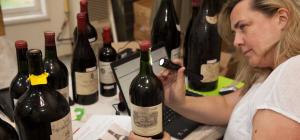
quote [ Fraudsters have long counterfeited high-end wine. Now they are coming for the bottles on your supermarket shelves ]
Everything fake the wines the grapes
Reveal In May 2014 Aleksandr Iugov, a 29-year-old Russian, drove six hours from his home in Milan to Burgundy, one of France’s most renowned wine-producing regions. He had an appointment to meet Pierre-Jean Marcus, the director of Wijncuriosa, a Belgian wine retailer, at a hotel. In March Marcus had bought 31 bottles of Domaine Leroy Musigny, an incredibly rare and expensive red wine, from Iugov. But Marcus soon had doubts about their authenticity, after he’d noticed that the wrong alcohol percentage had been printed on the labels. Marcus had asked Iugov to pick up the bottles and take them to the winery in Burgundy, where they would be authenticated. Just as Iugov and Marcus were about to eat in the hotel restaurant, there was a commotion around them. “Police,” shouted a group of armed officers, before snapping handcuffs on Iugov. The dinner date had been a sting. Grinning, Iugov claimed they’d got the wrong man. The officers arrested him anyway. In the boot of his car, they found several Russian passports: one for Aleksandr Anikin, his birth name, and two for Iugov, the name he had legally adopted in 2013. (Iugov initially said that Anikin was his twin brother.) The officers also found a dozen bottles, including a Romanée-Conti, one of the most coveted wines in the world. Wine connoisseurs value it for its bewitching combination of delicacy and depth. The American food critic Richard Olney has described it as “a fabulous thing—mysterious, sensuous, transcendental”. The estate, Domaine de la Romanée-Conti, produces several top wines, but only a few thousand bottles of Romanée-Conti each year; a single one can fetch tens of thousands of euros on initial release and similarly high figures on the secondary market, where many are subsequently traded. Romanée-Conti’s extraordinary value has made it a target for fraudsters. So too has its minimalist label—white, with no artwork—which makes it easier to counterfeit. Later that night, Iugov was taken to Dijon, Burgundy’s capital, and questioned. I recently met one of the lead investigators from the case for late-night beers at a bar in Dijon. Henri, as I’ll call him, told me that he had been investigating the alleged counterfeiting of Romanée-Conti bottles since 2012, when a few had been identified by a local restaurant owner as possible fakes. When Henri was first attached to the case, he told me he couldn’t believe it: why would anyone counterfeit wine? From experience, he suspected there were other things that criminals could fake more easily and profitably, like watches, handbags or clothes. But it didn’t take long before Henri became fascinated by the suspicious Romanée-Conti. “We had to learn everything about the bottles, about the wine, about the commerce,” he said. The investigation soon identified other victims of alleged fraud. It was difficult to connect the crimes because the person selling the Romanée-Conti bottles used different names in different countries. But investigators noticed that he always used the same phone number. They tapped it—which led them to Aleksandr Anikin. When Henri was first attached to the case, he told me he couldn’t believe it: why would anyone counterfeit wine? The investigators discovered that Anikin, now known as Iugov, had sold more than a hundred bottles of Romanée-Conti to wine retailers across Europe, including Wijncuriosa, between 2011 and 2013. They believed around 20 victims had collectively paid at least €2m, though the total amount was difficult to quantify because Iugov had funnelled the proceeds into several bank accounts, including ones linked to shell companies in Russia and the British Virgin Islands. After his arrest in Burgundy, Iugov claimed that he was unaware that the bottles were fake. He said he was selling them on behalf of Gideon Weinbaum, a wealthy entrepreneur he knew from Moscow. (Weinbaum died in 2014.) To support his account, Iugov produced financial documents, including one purporting to show a €1.5m ($1.6m) transfer to an account in Weinbaum’s name (investigators believe these had been fabricated after the dates of the supposed transactions). He also produced a photograph of a giant cake, shaped like a Romanée-Conti bottle and bearing the names “Anikin” and “Gideon”. Iugov said that the cake had been a gift to a client from him and Weinbaum in 2012 (emails later obtained by investigators showed that it had actually been ordered by Iugov’s mother from a bakery in 2014). At Iugov’s trial in January 2017 the judges dismissed his defence, noting his systematic acquisition of Romanée-Conti-related materials; for instance, Iugov had managed to obtain a label from the Domaine via email. He had also refunded nearly €100,000 to Weinbaum’s brother-in-law, who had raised concerns that the 21 bottles of Romanée-Conti he had bought were fake. The judges convicted Iugov of fraud and related offences arising from the movement and sale of counterfeit wines. He was sentenced to four years in prison (of which two were suspended), fined €150,000, and ordered to pay civil damages to several victims, including €300,000 to Domaine de la Romanée-Conti. At the bar in Dijon, Henri took a long sip of his beer as the staff wiped down the tables around us. He attended Iugov’s trial, and remembered being struck by how convincing and charming the man could be. “The problem isn’t just the bottles, it’s the guy,” Henri said. “Everyone trusts him. It’s incredible.” He was also begrudgingly impressed by how sophisticated Iugov’s operation seemed compared with other wine-fraud plots he’d researched, which tended to be smaller-scale and managed by lone actors. It was still a “mystery” to him how Iugov co-ordinated the sourcing and filling of the bottles, as well as the sales to buyers: “One person cannot do all that.” (The court had in fact concluded that Iugov wasn’t working alone, yet was unable to establish the identities or roles of his associates.) Henri called Iugov’s approach “organised crime with a commercial mindset”. But for all its reach, Iugov’s wine-fraud scheme was still crude compared with those being carried out today. In the dozen years since Iugov was first arrested, wine fraud has become more industrial in scale and scope, with small bands of organised criminals producing more—and more convincing—counterfeit bottles than ever before. Europe’s wine-producing nations have taken note of the growing problem. In 2020 the French gendarmerie created a specialist unit to tackle wine fraud; in the year to April 2025 it received 150 complaints linked to more than 100 criminal groups. The Italian Carabinieri launched 15 criminal investigations between 2024 and 2026, seizing nearly 400,000 litres of counterfeit wine worth around €2m. (According to Daniele Vescarelli, a commander with the Carabinieri’s Command for the Protection of Agri-Food Products in Italy, these figures are incomplete because other Italian authorities hold additional data on wine-fraud investigations.) Experts fear that counterfeiters are beginning to outmanoeuvre the authorities tasked with stopping them by expanding into mid-tier wines, where huge profits stand to be made from bottles that are worth hundreds of euros but cost barely anything to fake. Amid these industry-wide shifts, Henri and Iugov crossed paths again. A few years after his arrest in Burgundy, Iugov allegedly made a new and even more sophisticated attempt to sell counterfeit Romanée-Conti bottles; his trial on those allegations is currently pending. “It’s incredible,” Henri told me about the quality of the fakes, shaking his head. More than a third of his career, he noted, had been spent going after the same man. “People keep saying I am always against this guy but…it’s not my fault.” Wine has been faked “for as long as it has been drunk”, said Rebecca Gibb, the author of a history of the subject. But wine fraud intensified in the late 19th and early 20th centuries, when improvements in bottling, corking and transportation allowed wine to become more widely distributed. Fraudsters began passing off cheap or inferior bottles as products from prestigious regions. Wine-producing countries responded by introducing appellation systems, which restrict geographical names to wines made from specific grapes grown in defined areas according to established production standards. These laws made it easier to distinguish legitimate wines, and gave authorities a stronger basis for prosecuting anyone selling fraudulent ones. But instead of disappearing, wine fraud moved upmarket. After the second world war prices of rare bottles rose, drawing in rich collectors. “A different market was now being deceived, because fine wine was being traded like art,” Gibb said. And like art, these wine collections were painstakingly built over time: bottles were sought out and acquired, not for immediate consumption but as financial investments, or left to mature until a special occasion. More than a third of his career, Henri noted, had been spent going after the same man. “People keep saying I am always against this guy but…it’s not my fault” Fraudsters began sourcing high-value bottles from bars, restaurants and tasting events to refill with cheaper wine and recork—a scam called refilling “empties”. In the 2000s Rudy Kurniawan, an Indonesian living in Los Angeles, became one of its most successful practitioners, marketing his blends of cheaper vintages as prized releases from the likes of Domaine de la Romanée-Conti. Kurniawan’s scheme started to unravel in 2008, when he tried to sell dozens of bottles of a wine called Clos Saint-Denis at auction. The vintages dated as far back as 1945—yet Domaine Ponsot, the estate, hadn’t started producing Clos Saint-Denis until 1982. Laurent Ponsot, the winery’s owner, travelled to New York to halt the sale; he later provided evidence for the FBI, which was already investigating Kurniawan. When agents stormed Kurniawan’s home in 2012, they found old bottles soaking in the sink, piles of corks and thousands of fake labels. In 2014 a federal court sentenced him to ten years in prison, the first conviction in America for wine fraud. Rather than deterring criminals, Kurniawan’s conviction “put wine fraud on the map”, said Bill Edgerton, an American expert in wine authentication. Since then, the financial incentives have only grown, driven by surging demand and limited supply. Unlike most assets, wine is eventually consumed, so the pool of rare bottles steadily shrinks. At its peak in 2022 the Fine Wine 100 index, which tracks the sale prices of the most sought-after wines on the secondary market, had risen more than 77% since 2010. Even less celebrated wines, priced in the hundreds of euros rather than the thousands, have risen sharply in value over that same period. But it isn’t just the money that attracts fraudsters. According to Maureen Downey, another American wine authenticator, the Kurniawan case also highlighted the limited risks. No one connected to Kurniawan was ever charged with a crime, including several people believed to have funded his operation. In America a fraud conviction requires proof of criminal intent, something prosecutors couldn’t establish. Downey believes this created a dangerous precedent that fraudsters “can easily set up a fall guy”. The low risk is compounded because the market has few reliable ways of proving whether a bottle is real. Unlike cars or watches, bottles do not always carry unique identifiers. Provenance, the paper trail of ownership and storage, is often incomplete or missing, especially with older vintages. Much of the trade in fine bottles takes place either through specialist wine merchants or auction houses, where there is no legal obligation to verify authenticity; or through private emails, social media and online forums, where deals depend on trust between the buyer and seller. According to Downey, sellers have a strong incentive not to trace the origins of their bottles, because doing so could leave them open to accusations that they knowingly sold a fake. “It’s always easier to ask for forgiveness,” she said. “Outside of financial crimes, how many criminal endeavours could hope to generate millions in a couple of years without risking very lengthy jail time?” The onus therefore is on buyers to make inquiries into the origins of a prized bottle, but they don’t always think to do so. As Olivier Roberto, an authenticator who works with Downey, put it: “Your emotions can take over, and you close your eyes.” All this has created an opportunity for fraudsters, he added: “Outside of financial crimes, how many criminal endeavours could hope to generate millions in a couple of years without risking very lengthy jail time?” Over the past decade and a half organised criminal networks have spotted the potential of counterfeit wine, and steadily displaced the lone fraudsters of Kurniawan’s ilk. These groups are typically made up of just a handful of people, according to Vescarelli, the Carabinieri commander. They tend to be organised around at least one person with experience of the wine industry. Each member has a defined role, ranging from falsifying provenance documents and producing the labels to blending the fake wines and distributing them. According to Vescarelli, these groups are not dangerous, mafia-like organisations; nor are they sprawling criminal groups with many illicit income streams. Instead, people come together specifically to produce and market counterfeit wine for profit, then often disband; any other crimes these groups commit are usually in direct support of the counterfeiting operation. Rather than acquiring and refilling empties, which can attract attention and is difficult to sustain at scale, many of these criminal groups produce bottles from scratch, using commercially available tools such as glass moulds, high-resolution printers and corking machines. “It’s become easier for criminals to produce near-perfect replicas of wine bottles, down to the shape of the glass, capsules [the protective sleeves at the top of the cork] and corks,” said Gianluca Sabatino, head of the counterfeiting team at Europol. (Vescarelli fears that some groups are using artificial intelligence.) Anything they cannot produce themselves can be easily outsourced—which, as Michele Tamponi, a retired Carabinieri general, noted, can also help the criminals cover their tracks, as the orders are usually divided between several specialist manufacturers. The wine inside these bottles varies in quality. “Because each wine has its own sensory characteristics, each counterfeit requires a different approach,” Vescarelli said. Some groups use supermarket wines, or blends of them; others choose better-quality wine, especially if they’re looking for repeat business. Whereas French estates face strict legal caps on how much they can sell, Italian winemakers are generally free to unload surplus wine, provided it is stripped of its prestigious estate or appellation name. Criminal groups can then buy this surplus at a discount and put it into counterfeit packaging. “Usually, it’s hard to detect a difference,” Sabatino said, even in taste: the most expensive wines are so rarely drunk that there isn’t a reliable benchmark for comparison. The fresh allegations against Aleksandr Iugov reflect this changing environment for wine fraud. He had served the bulk of his sentence in pre-trial detention and was let go after his trial in 2017. By 2020 counterfeit Romanée-Conti bottles were surfacing again. This time the fakes were more refined, featuring corks, capsules and labels copied from the originals with precision. They also incorporated features designed to prevent counterfeiting, such as UV-reactive inks, which made it even harder to tell the real and fake bottles apart. “People were calling the domaine, saying there’s a problem,” Henri, the investigator who worked on the first Iugov case, told me when we met. At first, he didn’t suspect Iugov, but the evidence began to point towards him. “I thought: ‘It’s amazing, he never stopped,’” Henri said. French, Italian and Swiss authorities, together with Europol, collaborated on a renewed investigation into Iugov. In September 2024 they searched 14 locations in Turin and Milan, arresting five of Iugov’s associates (Europol wouldn’t say whether any of these people were ever charged). According to a Europol press release, investigators seized empty bottles, counterfeit labels, ingredients to refill the bottles and machines to recork them. Europol stated that hundreds of fake bottles were forged in Italy, then exported internationally to “honest wine traders” for up to €15,000 each. The European Union Agency for Criminal Justice Cooperation, which supported the investigation, reported that the alleged scheme generated the group more than €2m in profits. Iugov himself was arrested at Milan airport. When he saw Henri, he laughed. “Isn’t this a bit too far from Dijon for you?” he asked. Henri smiled back. He had his man again. With Iugov’s second trial still pending, Henri wouldn’t discuss the details of his most recent investigation. But as Downey pointed out, the latest allegations against Iugov show how suspected counterfeiters have been adapting to the security features designed to thwart them. Most visible security features can be replicated, and even when they’re applied imperfectly, they lend a sheen of authenticity. “Some wineries, in modernising, have inadvertently empowered counterfeiters to make better counterfeits,” she said. “If [the customers] see that something is glowing, they think that’s enough.” That hasn’t stopped wineries from trying to outsmart the fraudsters. Last year I travelled to Château Margaux, perched on the left bank of the Gironde estuary in Bordeaux, to learn how the makers of one of the world’s most desirable wines are trying to stay ahead. Aurélien Valance, the winery’s deputy managing director, met me in front of the estate’s 19th-century manor house, wearing a shirt and blazer. Margaux was among the first wineries that tried to make bottles that were harder to fake. It was done in anticipation of a threat, rather than in reaction to one: “We were pretty sure it would become a problem,” Valance told me. In 1989 the estate began laser-etching its bottles with an identification code. At first batches shared the same mark, but from 1995 each bottle carried a unique one. In 2011 Valance introduced a strip known as a Prooftag, which sits across the capsule and the bottle. It carries a code and a constellation of raised indentations that acts like a fingerprint. On the Prooftag website users can enter the code and cross-check that the indentations correspond with the real bottle. After a tour of the vineyard Valance uncorked a 2011 vintage, a favourite of his. “It really blossomed during covid,” he said. “Would you like to try?” Ruby in colour, it smelled sweet at first, before opening into floral notes. Valance closed his eyes as he swallowed, then pointed out how the year was embossed on the punt of the bottle, and the cork was laser-printed with minute details. For each vintage Valance commissions three producers to supply three different types of cork, all of which are used across the same release. If a bottle is in doubt, he can check whether the type of cork is right. “You need to have a precise record of this, because each cork is slightly different,” he said. Other popular anti-counterfeiting techniques used by high-end wineries include manufacturing proprietary bottle shapes and micro-printing, where text and patterns are printed at a scale visible only under magnification. (I was shown a bottle of 2009 Le Pin, a fine Bordeaux wine, where the names of the winery owner’s children had been micro-printed repeatedly between two thin red lines on its front label.) Some wineries have adopted advanced security measures, incorporating features like holograms, individualised digital tracking codes and inks that change colour when tilted. Pétrus, a Bordeaux winery which produces only 30,000 bottles a year, uses inks custom-made by the same company that produces the ones used on American dollar bills. I was shown a bottle of 2009 Le Pin, a fine Bordeaux wine, where the names of the winery owners’ children had been micro-printed repeatedly between two thin red lines on its front label Château Margaux’s tinkering with its own anti-counterfeiting features has helped keep forgeries at bay over the past 15 years. “We have seen a few fakes, but not as many as you’d expect,” Valance told me. Even so, he refuses to authenticate any bottles brought to him by customers. Certainty is never absolute, he said, because the chateau’s records don’t go back as far as its oldest vintages. And with newer bottles, criminals will always invent new ways to deceive. With technological advances, it’s become easier for them to replicate anti-counterfeiting measures than it is to convincingly reproduce the accumulated signs of age on older bottles. Some criminal groups are also prioritising quantity over quality. Rather than focusing exclusively on older, rarer vintages, fraudsters are moving downmarket, mass-producing fakes of even the lowest-quality wines. In 2010, for instance, counterfeit bottles of Louis Jadot Pouilly-Fuissé—which sold for under £20 each at the time—surfaced on the shelves of a British supermarket chain. And in 2020 a Moldovan gang smuggled fake Yellow Tail, a mass-market Australian wine, into Britain. It’s easier to counterfeit cheap bottles because they have standardised shapes and few, if any, security features; buyers are also less likely to inspect them closely. But in the experience of Sabatino, of Europol, the cheapest wines still pose too much of a risk for most criminal groups: “If you need to fill lots of bottles and share them around, the possibility of being caught is higher.” He believes the sweet spot for criminals is what he calls “medium” and “medium-high” wines—bottles selling between €50 and €300. They offer the best balance between risk and profit because the bottles are still standardised, with replicable anti-counterfeiting features, but the prices remain high and the chances of inspection are low. In 2020 Italian authorities dismantled a criminal network selling fake bottles of Sassicaia, which sells for around €300; they estimated that the group produced 700 cases of fake wine per month, generating around €400,000 in profits. As Etienne Paumier, a French wine authenticator, pointed out: “This is where criminals can make substantial money with fairly similar investments as for counterfeiting €20 wine.” All told, most wine fraud still targets the most prestigious vintages—and the richest oenophiles. To help them distinguish between real and fake bottles, some collectors, as well as merchants and auction houses, have come to rely on the services of wine authenticators like Edgerton, Downey, Roberto and Paumier. Sometimes known as “detectives”, these experts scrutinise wine bottles, looking for clues that something is amiss. They pay particular attention to the type of glass, the design and printing of the label, the integrity of the capsule and the gap between the liquid and the cork. (Because corks are not perfect seals, wine evaporates slowly. Too much liquid in an older vintage suggests a refill.) They usually don’t open the bottles to taste the wine, as that would destroy their value. It’s a time- and resource-intensive process that is by no means foolproof, nor is it standardised. Some people in the wine industry, like Laurent Ponsot, the winemaker who helped expose Kurniawan’s operation, believe the industry depends too heavily on authenticators, who require no formal training or certification and charge hefty fees for their services. But given the difficulties in ascertaining provenance, authenticators remain the best tool the industry currently has for sniffing out fake bottles. On a drizzly May morning I met Downey to see the work of wine authentication for myself. She had invited me to the wine cellar of 220 Central Park South, a luxury residential skyscraper on Manhattan’s Billionaire’s Row. As part of her job Downey manages private cellars: tracking inventory, sourcing new additions, and timing purchases and sales. A month earlier a truck had arrived with crates of rare bottles for one of Downey’s clients, a businessman living in a penthouse 40 floors above. He had bought bottles from one of London’s most prestigious wine retailers, and imported them along with hundreds more that he had stored in Europe. Now Downey had to check each bottle was real. She had flown in with Paumier and Roberto, whom she trained and now hires back for jobs. Their work as wine detectives isn’t as glamorous as it sounds. Instead of lavish lunches in fine hotels, they usually eat take-away sandwiches in dank cellars. “It’s like being a mole,” Roberto said. “They’re often so dirty that you want to grab a broom and just clean up.” This cellar, however, with its marble floors and glossy dark-wood panelling, looked more showroom than storage unit. Bottles in glass cabinets were backlit like diamonds in a jeweller’s window on Fifth Avenue. Each resident had their own section of the cellar, though Downey’s client had enough wine to fill three. Downey first encountered fake wine while working as an auctioneer in New York in the early 2000s. A client tried to consign to her a fake bottle of 1982 Pétrus. She picked it up and nearly threw it at the ceiling: the bottle was full, but the glass was cheaper and lighter than she had expected. “After you’ve touched a genuine bottle like this enough times, you know how it should feel in your hand,” she said. Soon she was spotting counterfeits everywhere. Seeing that passionate collectors “just needed qualified advice but the industry wasn’t giving it to them”, she quit auctioneering in 2005 to begin authenticating wines, teaching herself the process. To Downey, the prevalence of fraud was proof that the wine industry was losing the race against counterfeiters: “If you think too much about it, you’ll cry” At first, Downey said, many collectors and merchants preferred not to know their wine was fake. (She claimed one angry seller attacked her at a wine festival: “He went down like a football player and body slammed me.”) But demand for Downey’s services has since rocketed; she and her team can charge up to $8,500 a day. After our chat Downey and her colleagues got to work. Roberto would photograph each bottle, recording the colour and thickness of the glass. Paumier would then inspect the bottle with UV light and a microscope, noting the dimensions of the lip, neck and base. On the label and capsule, they would look for typos and cross-check fonts, spacing and textures with their private database of genuine bottles. In total, around 120 data points about each bottle were fed into Chai Vault, a digital registry for fine wines designed by Downey. The registry creates a digital passport for the bottle, recorded on the blockchain and updated as the wine changes hands (provided that buyers and sellers log each subsequent transaction). On a typical day Downey’s team can inspect and log 50 bottles. On a table there was a magnum of 1993 Cros Parantoux. It looked authentic enough, but Downey hadn’t seen a real one in decades. She cut the capsule with a blade and shone a torch inside. The cork’s writing was digitally printed, not fire-branded, as would be traditional. “Fake!” she exclaimed. Two bottles of 1947 Pétrus also caught the team’s attention. The fill level was suspiciously high for bottles of their age. Using a magnifying glass, Downey inspected the loop of the “R” in the winery’s name on the front label. “When it’s plate-pressed, that ink will not bleed and overlap with the U,” she said. But this time it was bleeding over, suggesting the fraudsters had used an inkjet printer, which leaves blurred edges on the paper. “I don’t love that at all.” She paused. The sale records indicated that the bottles had been personally authenticated by Olivier Berrouet, Pétrus’s manager. This should have closed the matter, she said, but “How do I know Olivier looked at these specific bottles?” She emailed the retailer in London, asking for evidence. By the following morning, Downey’s team had inspected 70 bottles; five of them, worth more than £200,000 ($265,600) in total, were considered counterfeit. She suspected many others were too. To her, the prevalence of fraud was proof that the wine industry was losing the race against counterfeiters: “If you think too much about it, you’ll cry.” Paumier was more angry with the retailer. “If you are selling something you should do what’s in your power, and to the best of your knowledge, to make sure it’s sound,” he said. He had written a paper calling for mandatory authentication protocols across sellers. “As an industry we need to grow up and regulate ourselves better.” Downey’s client was more sanguine when we visited him in his apartment; he simply shrugged when he heard about the fakes. No one thought it was worth going to the police. As Paumier explained, even an expert’s opinion is still just an opinion. “If [the authorities] have limited resources, they will choose finding a guy who threw his wife out of the window over helping a guy who purchased a bottle of Pétrus in an auction that may be bad.” A refund was the best the client could ask for, but that depended on the merchant’s goodwill (and nothing could stop that merchant from then trying to sell the wine on to someone else). Later, I joined the team for a glass of wine at a hotel bar. I asked Paumier if his job had affected his enjoyment of wine. He shook his head. The hardest part was telling people that the wine they’d saved to commemorate a special occasion might be fake. “That’s what really breaks my heart,” he said. Today, many of the bottles of Romanée-Conti at the centre of the second investigation involving Iugov still circulate. Downey told me she has identified a dozen of them, and that although she thought Iugov “got a lot right”, the work didn’t “look quite as good” as the real thing. She also remembered opening one bottle and thinking that it “tasted like absolute crap. Clearly he wasn’t looking for repeat business!” This summer I had the unexpected opportunity to ask Iugov himself about his business strategy. I had emailed him multiple times, but received no response; I assumed he was still in prison. But in August Iugov texted me, explaining that his lawyer had forwarded one of my messages. He suggested I visit him in Paris, where he now lives. We met at a wine bar a few days later. Iugov—tall, handsome, with an elongated face and cropped brown hair—sat across from me, wearing jeans and a lightweight jacket and swirling a glass of expensive Burgundy. He was charming and switched seamlessly between English and French in his conversations with me and the waiter, and between Russian and Italian in the calls he took. Iugov explained that a judge had released him on bail pending his trial; he is still presumed innocent under French law. He recalled the pain of being locked up for a second time. On the wall of his jail cell in Dijon, he saw his name where he’d engraved it years earlier, after his first conviction. “I thought, ‘Sasha, you are so stupid,’” he said. Several times Iugov asked me what was so bad about counterfeiting wine, pointing to the street vendors outside the bar brazenly selling fake handbags. “If I am so bad then in what world are we living?” He was born in Siberia in July 1984 and told me that he studied at Irkutsk State Linguistic University, hoping to become a clothing designer, before going to Moscow to look for work. “It’s difficult for someone who moves from nowhere to Moscow,” he said. “What can you do in life? I didn’t study at Princeton University.” A wine merchant he knew supposedly paid him to import wines from Europe to Russia. At the time, he said, he knew “nothing about Burgundy wines at all”. In 2010 he broke up with a girlfriend and moved to Milan: “It was just an emotional decision.” There Iugov said he started out by buying and selling furniture. Then he repeated the same account he’d given to investigators after his first arrest: that he sold wine on behalf of Gideon Weinbaum. According to Iugov, two or three times a month he would receive a batch of bottles from one of Weinbaum’s associates, which he would sell at a below-market rate to a handful of wine merchants. He recalled being shocked to learn that “wine could exist for so much money”. Iugov would deliver the proceeds in cash, minus a cut, to Weinbaum, who lived in Düsseldorf. Iugov told me that until Pierre-Jean Marcus, of Wijncuriosa, raised concerns, he had never considered that the bottles he was selling might be fake. “They gave me the bottles, I deliver it to professional clients…and if the professional clients say it was original wine, then it’s original wine. I trust their knowledge.” Why would he have agreed to meet Marcus and pick up his bottles if he himself doubted their authenticity, Iugov asked? In 2019, after his first trial, Iugov said that a Russian friend of Weinbaum’s allegedly asked him to produce counterfeit bottles of Romanée-Conti. “He said to me, you know the wine, you speak languages,” Iugov recalled. He said he commissioned an Italian printing specialist to create the label, giving him money to buy an original one to replicate. “He produced the labels. He knew how to do it. I was involved because I took the labels. But I never knew any technical part.” According to Iugov the bottles were supplied by a high-end manufacturer, and his Russian partner filled them with supermarket wine: “He was just buying it in the stores and filling it up.” Iugov wouldn’t reveal to me where the capsules had come from or where everything was put together, but he did say that investigators had identified him after they found his fingerprints on one of the labels and tapped his phone as he appeared to be ordering more. “If [the authorities] have limited resources, they will choose finding a guy who threw his wife out of the window over helping a guy who purchased a bottle of Pétrus in an auction that may be bad” But Iugov claimed that the authorities had overestimated the scale of the alleged scheme. He had to order the labels and bottles in large quantities, he said, but few were sold as counterfeit bottles. Those he did sell were cheap. “They saw lots of labels and bottles, but there are no victims,” he said, before pausing. “Never in my life have I sold anything for €15,000!” He said that he wouldn’t be living in a one-bedroom rental apartment if that were the case. Several times he asked me what was so bad about counterfeiting wine, pointing to the street vendors outside the bar brazenly selling fake handbags. “If I am so bad then in what world are we living?” Iugov’s frustration was compounded because he felt he was being singled out. “I don’t want to tell you that I’m innocent. I am not innocent, not at all. But I’m not alone,” he said. He is most angry with the retailers who willingly bought and sold the fake bottles, claiming that they must have known that the bottles were counterfeit because they had paid so little for them: “You cannot buy a Rolex on the street and think it’s an original one!” (In its first ruling, the court found the merchants who sold the counterfeit wine were partly at fault, reducing the compensation Iugov was required to pay them.) “Nobody is asking them, but everyone is fucking me,” he said. Iugov was at his most expressive, however, when he spoke about Henri, the investigator in Dijon. As Henri pursued the first investigation, he had struck Iugov as peculiarly dogged. “He was always looking at me and smiling, trying to find something more,” Iugov said. “He was always thinking it’s bigger…like it’s Russian mafia…Why does he hate me so much? That’s my question. There are no bodies. It’s just fake wine.”■
|
Comments
 |
stv179 said @ 11:55am GMT on 13th Nov
Unfortunately blocked here ..
|
Post a comment
[note: if you are replying to a specific comment,
then click the reply link on that comment instead]You must be logged in to comment on posts.

